

For years, sick pay was one of the few bits of employment admin a small business could half-ignore. Somebody was off for a couple of days, the first three days were unpaid "waiting days" anyway, and if they earned below the threshold there was nothing to pay at all.
That changed on 6 April 2026. Statutory Sick Pay is now paid from the first full day of sickness, the earnings threshold that shut out the lowest-paid workers is gone, and around 1.3 million people who never qualified before are now entitled to it. For a business running a shift team on variable hours, this is not a footnote. It is a new line in the cost of every absence.
This is a plain-English guide to how SSP works now, with the arithmetic worked through.
The short version: almost every employee now gets SSP from day one of sickness, for up to 28 weeks. It is paid at the lower of £123.25 a week or 80% of their average weekly earnings. There are no more unpaid waiting days and no minimum earnings limit, and you cannot claim any of it back from HMRC.
This is general guidance, not legal advice. It reflects the position in Great Britain from 6 April 2026; check GOV.UK or take advice for anything unusual, and note that some rules differ in Northern Ireland.
Three things changed on 6 April 2026
Statutory Sick Pay itself is not new. What changed this April is who gets it, when it starts, and how much the lowest earners receive. Three reforms landed at once:
- Waiting days are gone. SSP used to start on the fourth qualifying day of an absence, so short spells of sickness were effectively unpaid. It is now payable from the first full day.
- The Lower Earnings Limit is gone. Previously you had to earn at least the Lower Earnings Limit (£125 a week in 2025/26) to qualify at all. That gate has been removed, so part-time and low-paid staff now qualify regardless of what they earn.
- A new 80% rule for low earners. To pair with the removed threshold, SSP is now the lower of the flat weekly rate or 80% of the worker's average weekly earnings. Nobody can be paid more in sick pay than they would earn working.
Taken together, these are the biggest changes to SSP in a decade, and they fall hardest on employers with lots of part-time or variable-hours staff, because that is exactly the group the old threshold used to exclude.
The one number, and the one rule
From 6 April 2026 the flat rate of SSP is £123.25 a week, up from £118.75. But the flat rate is only half the story, because it is now a ceiling rather than a fixed figure.
The rule is: SSP is the lower of £123.25 a week, or 80% of average weekly earnings.
For anyone earning roughly £154 a week or more, 80% of their pay is above £123.25, so they get the flat rate. Below that crossover, the 80% figure is lower, so that is what they get. The chart below shows where the switch happens.
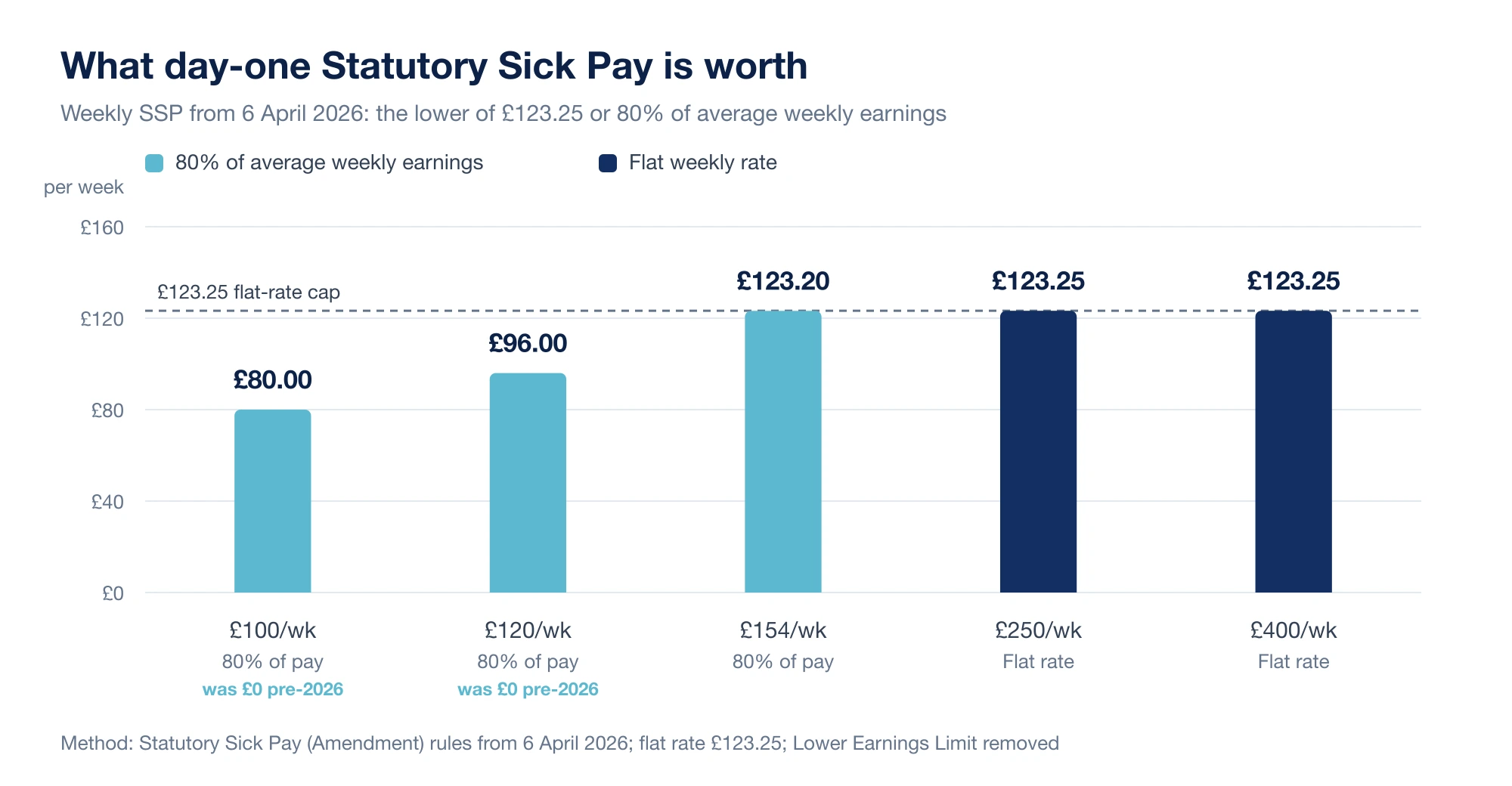
| Average weekly earnings | 80% of earnings | SSP paid | Before April 2026 |
|---|---|---|---|
| £100 | £80.00 | £80.00 | £0 (below the old limit) |
| £120 | £96.00 | £96.00 | £0 (below the old limit) |
| £154 | £123.20 | £123.20 | £118.75 flat rate |
| £250 | £200.00 | £123.25 | £118.75 flat rate |
| £400 | £320.00 | £123.25 | £118.75 flat rate |
Average weekly earnings are worked out over the eight weeks before the sickness started, using the pay that had National Insurance charged on it. For staff whose hours move around week to week, that eight-week average is doing real work, and it is only as reliable as the hours you actually recorded.
When SSP starts, and what counts as a "day"
SSP is paid for qualifying days, which are the days the person would normally have worked. Someone who works Monday to Friday has five qualifying days a week; someone who works two shifts a week has two.
The daily amount is the weekly figure divided by the number of qualifying days in that week. For a five-day worker on the flat rate, that is £123.25 ÷ 5 = £24.65 a day. For a two-day worker on the flat rate, each qualifying day is worth £61.63, because the same weekly amount is spread over fewer days.
Since April 2026 there are no waiting days, so the very first qualifying day of the absence is paid. SSP then runs for as long as the person is off sick, up to a maximum of 28 weeks in any one period.
One wrinkle worth knowing: separate absences that fall within eight weeks of each other are "linked" and treated as a single period for the 28-week limit. Somebody who is off for a week, comes back for a fortnight, then goes off again has not reset the clock. This is why sickness needs to be recorded against a person over time, not just noticed in the moment.
A worked example
Priya works Monday to Friday and her average weekly earnings are £180. She is off sick from a Wednesday and does not return until the following Thursday.
- 80% of £180 is £144, which is above the £123.25 cap, so she is on the flat rate.
- Her daily rate is £123.25 ÷ 5 = £24.65.
- Under the old rules, the Wednesday, Thursday and Friday would have been unpaid waiting days and SSP would only have started the next Monday. Now every qualifying day is paid from the Wednesday.
- Qualifying days missed: Wed, Thu, Fri, then Mon, Tue, Wed of the next week — six working days at £24.65 = £147.90 of SSP, all of it a direct cost to the business.
Run the same absence for a part-time worker earning £110 a week and the picture is different again: 80% of £110 is £88, so their weekly SSP is £88 and their daily rate is lower, but crucially they now get something, where before April 2026 they would have got nothing.
You cannot claim any of it back
This is the part that catches out new employers. There is no scheme to reclaim SSP from HMRC. The old Percentage Threshold Scheme, which used to refund some SSP to smaller employers, was abolished in 2014 and has not returned. Every pound of SSP is a direct cost to your business.
That is what makes the 2026 changes a real budget item rather than a payroll technicality. Paying from day one instead of day four, and bringing in the lowest-paid quarter of your team, both push the annual bill up. It is worth modelling what a normal amount of short-term absence now costs you, because it is no longer close to zero.
Occupational sick pay sits on top
SSP is the legal floor, not the ceiling. Plenty of employers offer contractual (occupational) sick pay that is more generous, such as full pay for the first few weeks of certified sickness.
If you do, the rules are yours to set, but write them down clearly: how long enhanced pay lasts, when it drops to SSP, and whether it resets each leave year. Where you pay occupational sick pay, it normally includes the SSP you would have paid anyway, rather than being added on top of it. If you do not offer anything extra, that is allowed, but say so in the contract so nobody assumes otherwise after their first week off.
Who qualifies, and the paperwork that goes with it
Since the earnings threshold went, the qualifying test is much simpler. To get SSP a person generally needs to:
- Be classed as an employee or worker for tax purposes (on PAYE), which includes most agency workers. Genuinely self-employed contractors are not covered.
- Have started work for you and then been off sick.
- Tell you they are sick within your notification deadline, or within seven days if you have not set one. You can ask for reasonable notice but cannot insist it be in a particular form or require a doctor's note for the first week.
A few pieces of paperwork still matter:
- Fit notes. You can ask for a fit note (the "statement of fitness for work") once someone has been off for more than seven days in a row, including non-working days. For anything shorter, self-certification is enough.
- The SSP1 form. If someone does not qualify for SSP, or their 28 weeks are running out, give them an SSP1 so they can claim Universal Credit or Employment and Support Allowance instead.
- Records. You are no longer legally required to keep SSP records in a set format, but HMRC can ask you to show how you worked a payment out, so keep dated sickness records and the earnings you based the calculation on.
Connect sickness to the rota, or you will pay twice
The mechanics above only work if the absence is captured accurately, and this is where small businesses lose money without noticing.
An absence that is not logged against a shift is one you cannot cost, cannot average correctly, and cannot defend if it is queried. Worse, an open shift nobody has reassigned is a double hit: you are paying SSP for the person who is off and scrambling to cover their shift at short notice. Most sick-pay disputes in small teams are not really about the rules, they are about nobody being sure which days someone was actually down to work.
The fix is to keep sickness in the same place as the schedule. When an absence is recorded against the shift on the rota, the qualifying days are obvious, the attendance record shows exactly what was and was not worked, and the hours feeding your eight-week average come straight off approved timesheets rather than a manager's memory. Booked leave and absence sitting on the same grid means the cover gap is visible the moment someone calls in sick, not the morning of the shift.
What to check in your own business this week
- Is your payroll paying SSP from day one, with the old three waiting days switched off?
- Are your lowest-paid and part-time staff now being assessed for SSP, rather than screened out by an earnings threshold that no longer exists?
- For variable-hours staff, is the eight-week average built from recorded hours you actually trust?
- Do your managers know a fit note can only be asked for after seven days, not on day one?
- Does your contract say clearly whether you pay only SSP or something more generous on top?
- When someone calls in sick, is the absence recorded against their shift, so cover and pay are handled from the same record?
Each "no" on that list is either a compliance gap or a bill you are paying without seeing. Weekola keeps the rota, attendance, timesheets and absence in one place, so a sick day is recorded once and the qualifying days, the hours and the cover gap all read off the same grid. If you are still totting hours up by hand for the average, the payroll hours calculator will take that arithmetic off you in the meantime.