

Full-time holiday is easy. Five days a week, 5.6 weeks, 28 days including bank holidays, done.
Then you hire somebody who works three days a week, somebody else who works school hours in term time only, and a third person on a zero-hours contract who did 62 hours in April and 11 in May. Suddenly the question "how much holiday have I got left?" takes a manager forty minutes and a spreadsheet nobody trusts.
This is a plain-English guide to getting it right, with the arithmetic worked through.
The short version: everyone gets 5.6 weeks. For fixed part-time hours, multiply days worked per week by 5.6. For genuinely irregular hours or part-year work, holiday accrues at 12.07% of the hours actually worked in each pay period, and can be paid as an uplift on each payslip if you choose.
This is general guidance, not legal advice. The rules below reflect the position in Great Britain; check GOV.UK or take advice for anything unusual, and note that Northern Ireland has not adopted all of the same reforms.
This affects more of your team than you think
Around 8.5 million people work part time in the UK, roughly a quarter of everyone in work, and about 1.17 million are on zero-hours contracts. In accommodation and food services, close to a third of the workforce is on one.
For a small hospitality or retail team, the people whose holiday is hardest to calculate are often the majority of the rota. Getting the method right once is worth considerably more than getting it approximately right every month.
Start from the one number that never changes
Almost every worker in the UK is entitled to 5.6 weeks of paid holiday per leave year. Not 28 days. Weeks.
That distinction is the whole article. Twenty-eight days is simply what 5.6 weeks looks like for somebody who works five days a week, and 28 days is also the statutory cap, so a person working six days a week does not get 33.6.
There is no separate legal right to bank holidays off. An employer can count them inside the 5.6 weeks, or give them on top, but the contract has to say which. Whatever you choose, write it down, because "we always close on Boxing Day" is not a policy anyone can calculate against.
Fixed part-time hours: multiply by 5.6
If somebody works the same days every week, the calculation is one line.
Days worked per week × 5.6 = annual holiday entitlement in days.
| Working pattern | Calculation | Entitlement |
|---|---|---|
| 5 days a week | 5 × 5.6 | 28 days |
| 4 days a week | 4 × 5.6 | 22.4 days |
| 3 days a week | 3 × 5.6 | 16.8 days |
| 2.5 days a week | 2.5 × 5.6 | 14 days |
| 2 days a week | 2 × 5.6 | 11.2 days |
A day of holiday means one of that person's normal working days. If Nadia works three long ten-hour days, one holiday day covers ten hours of pay, not a notional eight.
Where day lengths vary, it is usually cleaner to run entitlement in hours: weekly hours × 5.6. Somebody on 20 hours a week gets 112 hours of paid holiday a year, and booking a five-hour shift off deducts five hours. Teams who move to hours-based tracking almost always stop arguing about half days.
Bank holidays for part-timers
This is where good employers accidentally create unfairness. If your part-timers never work Mondays, and bank holidays sit inside the 5.6 weeks, they will lose out compared with a Monday-working colleague unless you handle it.
The standard fix is to run everything in hours. Calculate total entitlement in hours, deduct bank holidays from it only when the person would actually have worked that day, and let people take the balance when they choose. It is a five minute policy decision that prevents a recurring annual grievance.
Irregular hours and part-year workers: the 12.07% rule
For leave years beginning on or after 1 April 2024, there is a separate system for two groups:
- Irregular hours workers, whose paid hours in each pay period are wholly or mostly variable under their contract. Most genuine zero-hours and casual staff sit here.
- Part-year workers, who are contracted to work only part of the year and have periods of at least a week where they neither work nor get paid. Term-time-only staff are the classic example.
For these workers, holiday accrues as they work: 12.07% of the hours worked in each pay period, rounded to the nearest hour, with 30 minutes or more rounding up.
Where does 12.07% come from? A leave year has 52 weeks, of which 5.6 are holiday, leaving 46.4 working weeks. 5.6 ÷ 46.4 = 0.1207. It is just the same 5.6 weeks, expressed as a percentage of time actually worked.
Worked example
Sam is on a zero-hours contract and paid monthly.
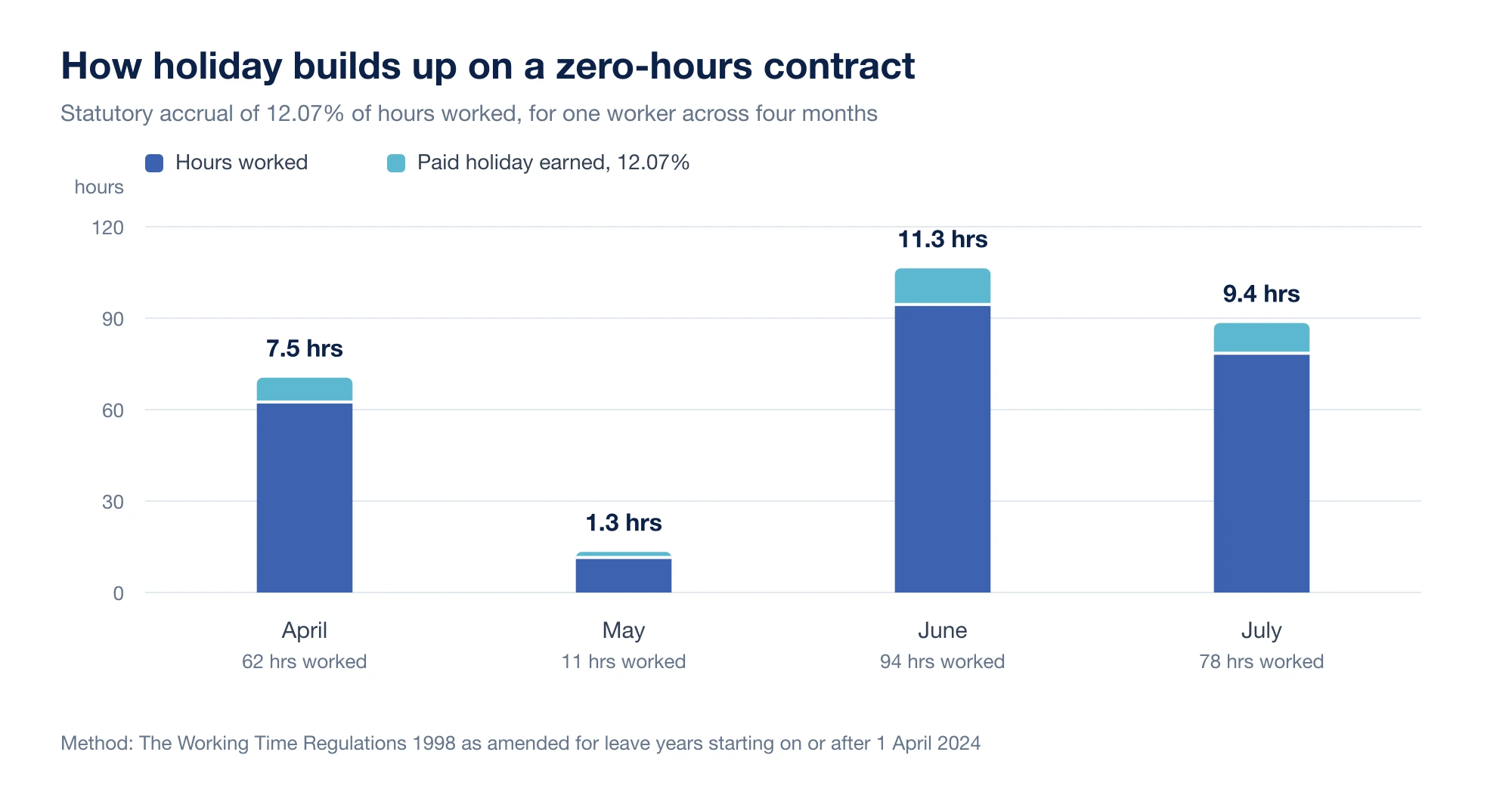
| Month | Hours worked | Accrued at 12.07% | Rounded |
|---|---|---|---|
| April | 62 | 7.48 hrs | 7 hrs |
| May | 11 | 1.33 hrs | 1 hr |
| June | 94 | 11.35 hrs | 11 hrs |
| July | 78 | 9.41 hrs | 9 hrs |
| Total | 245 | 28 hrs |
Sam has 28 hours of paid holiday banked by the end of July. If a shift is normally seven hours, that is four days off.
Two things make this workable in practice. The first is that hours worked have to be accurate, which means the accrual is only as good as your attendance records and timesheets. The second is that the running balance has to be visible to the worker, or you will answer the same question every month.
Rolled-up holiday pay is allowed again, for these workers only
For irregular hours and part-year workers with leave years starting on or after 1 April 2024, you may pay holiday as an uplift of 12.07% on the pay for the work done in each period, rather than paying it when leave is taken.
If you use it:
- It applies only to irregular hours and part-year workers, not to your fixed part-timers.
- The uplift must be itemised separately on the payslip.
- It is paid at the same time as the pay for that period, not saved up.
- The worker still has the right to take the time off. Rolled-up pay covers the money, not the rest.
That last point gets forgotten. Somebody being paid the uplift still needs to be able to book a fortnight off without pushback, and the rota still has to cope. If your business genuinely cannot release casual staff for leave, rolled-up pay has not solved the problem, it has just moved it into a policy you are not following.
Working out holiday pay when earnings vary
Entitlement is one question. What you pay for a holiday day is another.
For workers whose pay varies, holiday pay is based on average weekly earnings over a 52-week reference period, ignoring any week in which no pay was received and going back up to 104 weeks to find 52 paid weeks. If somebody has worked for you for less than 52 weeks, use the number of complete weeks you have.
Include the things that are part of normal pay: overtime worked regularly, commission, and shift or role premiums. A holiday should not amount to a pay cut for somebody whose normal week routinely includes a Saturday premium.
Carry-over, and what happens at the end of the year
The default is that leave is taken in the leave year it accrues, and untaken statutory holiday cannot be paid off in cash except when employment ends.
Three exceptions worth knowing:
- Sickness. Leave a worker could not take because of long-term sickness can be carried over, and must be used within 18 months of the end of the leave year it came from.
- Family leave. Someone on maternity or other statutory family leave keeps accruing holiday and can carry it into the next year.
- You prevented it. Where an employer did not give a real opportunity to take leave, or never told people they would lose it, that leave can carry over. It is worth sending a reminder in the last quarter of your leave year for exactly this reason.
Anything above the statutory minimum that you offer contractually is yours to define, so say clearly in the contract whether contractual extra days carry over, expire, or can be bought back.
Set up your leave year so the admin is survivable
A few decisions, made once, remove most of the recurring work:
- Pick one leave year for everyone. Anniversary-based leave years mean pro-rating every new starter and every leaver separately, forever. A common leave year, usually 1 January or 1 April, is far less work.
- Track in hours, not days, if anybody works variable shift lengths.
- State the bank holiday rule in the contract and in one place staff can read.
- Show a running balance people can check themselves.
- Book leave before the rota is built, not after it is published, so approved absence is on the grid while you plan the week.
That fifth point is the one that saves the most stress. Most leave disasters in small businesses are not calculation errors, they are somebody being scheduled for a Thursday they booked off in March. A leave management system that shows booked absence inside rota planning removes an entire category of mistake.
What to check in your own business this week
- Does every worker have a written entitlement figure, in days or hours?
- Are your irregular hours and part-year workers accruing at 12.07% of hours worked?
- If you use rolled-up holiday pay, is it itemised on the payslip and limited to the right group?
- Do part-timers lose out on bank holidays under your current method?
- Can a staff member see their own balance without asking a manager?
- Is booked leave visible while the rota is being built?
Each "no" on that list is a predictable argument waiting for a busy week. Weekola keeps requests, approvals, balances and the rota in one place, so entitlement is calculated once and everybody is looking at the same number. If you are still working hours out by hand, the payroll hours calculator will take the arithmetic off you in the meantime.