

"How long a break do they get on an eight-hour shift?" is one of those questions that sounds simple until three people give you three different answers. The rules are not actually complicated, but they are easy to breach by accident, because most of them are about the gaps between shifts rather than the shifts themselves, and gaps are exactly what a busy rota tends to squeeze.
This is a plain-English guide to the working time rules a small business has to build its rota around, with the numbers you can plan against.
The short version: most adult workers get a 20-minute break once a shift passes six hours, 11 hours' rest between shifts, and one day off a week. Their hours cannot average more than 48 a week unless they have opted out in writing. Night workers and under-18s have tighter limits that nobody can opt out of.
This is general guidance, not legal advice. It reflects the Working Time Regulations 1998 as they apply in Great Britain; check GOV.UK or take advice for anything unusual.
The rule most rotas break without noticing
Ask a manager about working time and they think about the length of a shift. The law mostly cares about the space around it.
A worker can finish a late shift at 11pm and, if the rota has them back on at 7am, that is only eight hours of rest, not the eleven the law requires. Nobody worked too long. Nobody skipped a break. The rota still broke the rules, because the gap between two legal shifts was too short.
That is the pattern behind most working time breaches in small businesses. They are not marathon shifts, they are close-together ones, and they only show up when you look at a person's week end to end rather than one day at a time.
Breaks during a shift: the 20-minute rule
An adult worker whose shift is more than six hours is entitled to a 20-minute rest break during it. The detail is where employers slip up:
- It has to be one uninterrupted block, not two ten-minute breathers.
- It cannot be tacked on to the start or end of the shift. A break exists so people rest partway through, so sending someone home 20 minutes early does not count.
- It is normally unpaid, unless the contract says otherwise or you have agreed to pay it. Many employers do pay short breaks, but that is a choice, not a requirement.
- A six-hour shift, exactly, triggers no statutory break at all. It has to exceed six hours.
There is no legal right to a second break on a longer shift, though plenty of good employers give more. The 20 minutes is a floor, not a target, and a hungry, tired team on a ten-hour day with a single 20-minute break is compliant but not well run.
Rest between shifts, and rest across the week
Two gaps matter more than the break, because they are the ones a rota quietly erodes.
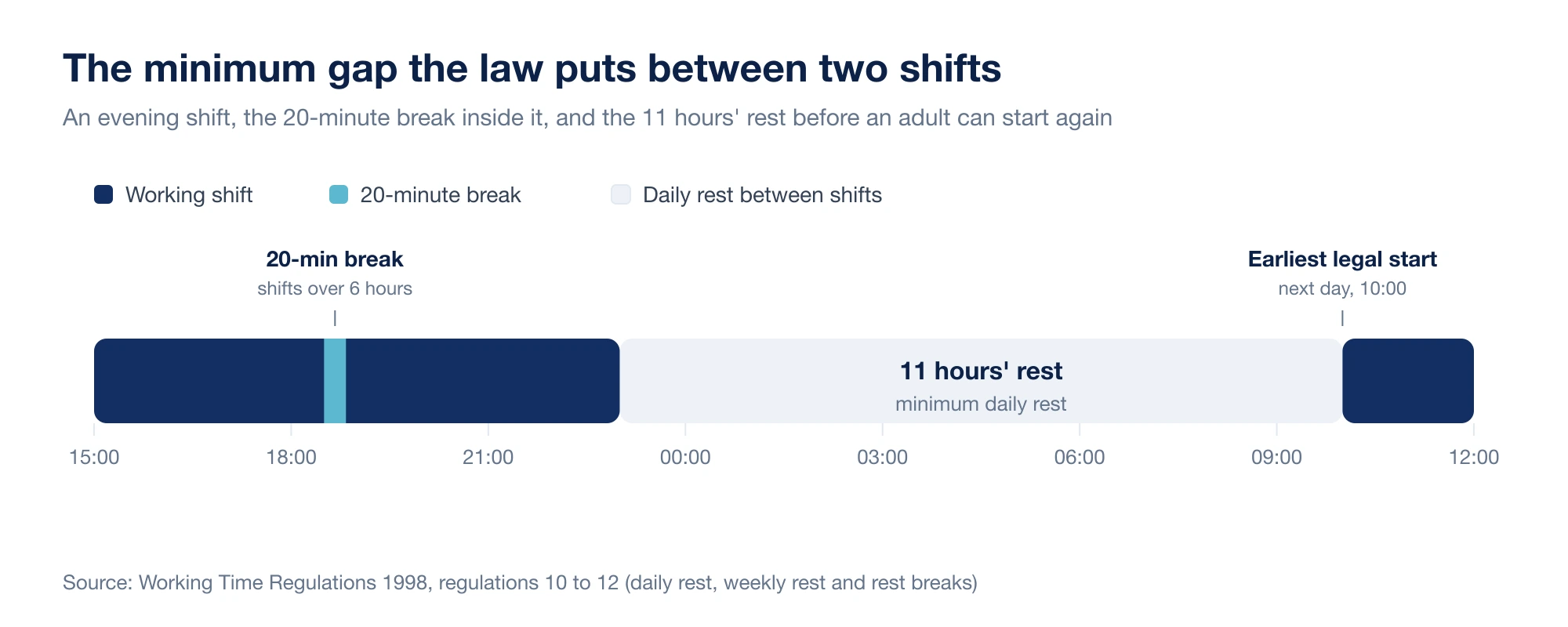
Daily rest. An adult worker is entitled to 11 consecutive hours of rest in each 24-hour period. In practice this sets the earliest a person can start the morning after a late finish. Close at 11pm and the same worker cannot legally be back before 10am, as the chart above shows.
Weekly rest. Workers are entitled to 24 hours of uninterrupted rest every 7 days, or 48 hours every 14 days if you would rather average it over a fortnight. A run of shifts that never leaves a clear day off is the other common breach, and it hides easily when you build the rota a week at a time.
| Entitlement | Adult worker (18 and over) |
|---|---|
| Break during a shift | 20 minutes if working more than 6 hours |
| Rest between shifts | 11 uninterrupted hours per 24 hours |
| Weekly rest | 24 hours per 7 days, or 48 hours per 14 days |
| Maximum weekly hours | 48, averaged over 17 weeks (opt-out available) |
Where a break or rest genuinely cannot be given, for example an emergency or a sudden shift change, the worker should get compensatory rest, an equivalent period of rest taken soon afterwards. It is a safety valve for exceptions, not a way to run the rota permanently short of rest.
The 48-hour week, and the opt-out
An adult's working time cannot average more than 48 hours a week, measured over a rolling 17-week reference period. Because it is an average, a genuinely busy fortnight is fine as long as quieter weeks bring the average back down.
A worker can choose to opt out of the 48-hour limit, but the opt-out has rules of its own:
- It has to be voluntary and in writing. You cannot make signing it a condition of the job or of getting shifts.
- The worker can cancel it by giving notice, up to three months if that was agreed, otherwise seven days.
- It only lifts the 48-hour average. It does not touch the break, the daily rest or the weekly rest, and it does not apply to the night-work limit.
Keep the signed opt-outs on file. If the question ever comes up, "they agreed verbally" is not a record.
Night workers have their own, tighter limit
If someone regularly works at least three hours during the night period (usually 11pm to 6am), they are a night worker, and a separate cap applies: their normal hours cannot average more than 8 hours in any 24-hour period, again over a 17-week reference.
Two things make this stricter than the day-time limit:
- There is no opt-out. Even a worker who has signed away the 48-hour average is still held to the 8-hour night limit.
- Where the work involves special hazards or heavy physical or mental strain, the 8 hours becomes an absolute cap on any 24-hour period, not an average.
Night workers are also entitled to a free health assessment before they start and at regular intervals after, and you should keep a record that you offered it.
Under-18s: different numbers, no opt-out
Workers over school leaving age but under 18 are on a separate, tighter set of limits, and crucially they cannot opt out of any of them:
| Entitlement | Worker under 18 |
|---|---|
| Break during a shift | 30 minutes if working more than 4.5 hours |
| Rest between shifts | 12 hours per 24 hours |
| Weekly rest | 48 hours (usually two full days) |
| Maximum hours | 8 hours a day and 40 hours a week, no averaging |
There are also night-work restrictions: under-18s generally cannot work between 10pm and 6am (or 11pm and 7am if their contract allows later work), and there is a hard prohibition on working between midnight and 4am. If your team includes college-age weekend staff, these are the limits that catch people out, because the adult opt-out and averaging simply do not exist here.
What this means for building a rota
The rules above are all about time between shifts, which is precisely what a spreadsheet built one week at a time cannot see. A few habits keep you the right side of them:
- Read the rota by person, not by day. The breaches hide in one worker's week, not in any single shift. Check each person's finish-to-start gaps and that everyone has a clear day off.
- Set a floor on turnaround. A "no shift starts within 11 hours of the last one finishing" rule, or 12 for under-18s, catches the classic close-then-open trap before it reaches the rota.
- Flag your night workers and under-18s. Their tighter, no-opt-out limits are the ones with the least room for error, so they need to be visible while you plan, not discovered afterwards.
- Record what actually happened. Averages over 17 weeks and proof that breaks were available both depend on real hours, which means the rota needs to reconcile against attendance and approved timesheets, not just the plan.
This is where keeping the schedule in one place earns its keep. When rest gaps, day-off patterns and night-worker limits are checked as the rota is built, compliance is a by-product of planning rather than an audit you do later. It matters for shift swaps too: a swap that looks like a simple favour can quietly drop someone below 11 hours' rest, so the same checks need to run when shifts move, not only when they are first set.
What to check in your own business this week
- Does anyone regularly get less than 11 hours between finishing and starting again?
- Does every worker get a clear 24 hours off each week, or 48 across a fortnight?
- Are breaks a single uninterrupted 20 minutes in the middle of longer shifts, not shaved off the end?
- Do you hold a signed, voluntary opt-out for anyone whose hours can top 48 on average?
- Are your night workers kept under the 8-hour average, and have they been offered a health check?
- Are your under-18s inside the 8-hour day, 40-hour week and night limits, with 30-minute breaks?
Each "no" is a breach waiting for a complaint or an inspection. Weekola keeps the rota, swaps, attendance and timesheets in one place, so rest gaps and hour limits are visible while you plan rather than reconstructed afterwards. If you just need the hours totalled to check an average, the payroll hours calculator will do the arithmetic. For the paid-holiday side of the same regulations, see our guide to holiday entitlement for part-time and zero-hours staff.