

If you search for a legal minimum notice period for changing a shift in the UK, you will find confident answers ranging from 24 hours to two weeks. As at 19 August 2026, none of those numbers is a general statutory minimum for most workers.
The current answer depends first on the employment contract: what hours and days it guarantees, and whether it clearly allows them to vary. The Employment Rights Act 2025 creates new rights for eligible zero-hours, low-hours and agency workers, but the government's latest timeline places them in 2027 and the regulations still have to set the key numbers.
The short answer: give as much notice as reasonably possible, check the worker's written terms before moving a shift, ask rather than assume where the change falls outside them, and keep a record of the original rota, the amendment, when notice was sent and what the worker agreed. Do not describe the 2027 notice and cancellation-payment rights as current law yet.
Law checked: 19 August 2026. This is general information for Great Britain, not legal advice. Employment law differs in Northern Ireland; use nidirect or the Labour Relations Agency there.
Is there a legal minimum notice period for shift changes in the UK?
Not a single number that applies to every employer and every shift today.
The government's own impact assessment states that, before the new regime takes effect, there is no legislation mandating advance notice of shift timings or changes for the workers it studied. That does not mean an employer can change any shift however it likes. The contract, written statement, discrimination law, working-time rules and the implied duty of trust and confidence still matter.
Start with the written statement of employment particulars. GOV.UK says it must state the hours and days of work and if and how they may vary. That creates three common situations:
| What the terms say | What a manager should do |
|---|---|
| Fixed days and fixed hours | Get agreement before making a material change; do not treat the rota as permission to rewrite the contract |
| Variable days or a clear flexibility clause | Use the clause reasonably, give reasonable advance notice and consult where the impact is significant |
| Zero-hours or casual arrangement | Confirm each offered shift and any change clearly; do not confuse no guaranteed work with no need for an accurate record |
A flexibility clause is not a blank cheque. Acas says it should be clear, should provide reasonable advance notice, and must only be used to make reasonable changes. Using one without reasonable notice or consultation can create breach-of-contract or constructive-dismissal risk.
How much notice should an employer give in practice?
Use two tests: what the contract permits and what the person can reasonably act on.
Two weeks is a sensible operational target for a routine rota in many small businesses, but it is a planning standard, not a universal legal rule. Earlier is better where staff need to arrange childcare, travel, study or another job. For an emergency change, the question becomes whether you asked, explained and recorded rather than silently overwrote the rota.
The size of the problem is why legislation is changing. Department for Business and Trade material reports that 78% of variable-hours workers receive less than two weeks' notice, 59% less than one week, and 13% less than 24 hours.
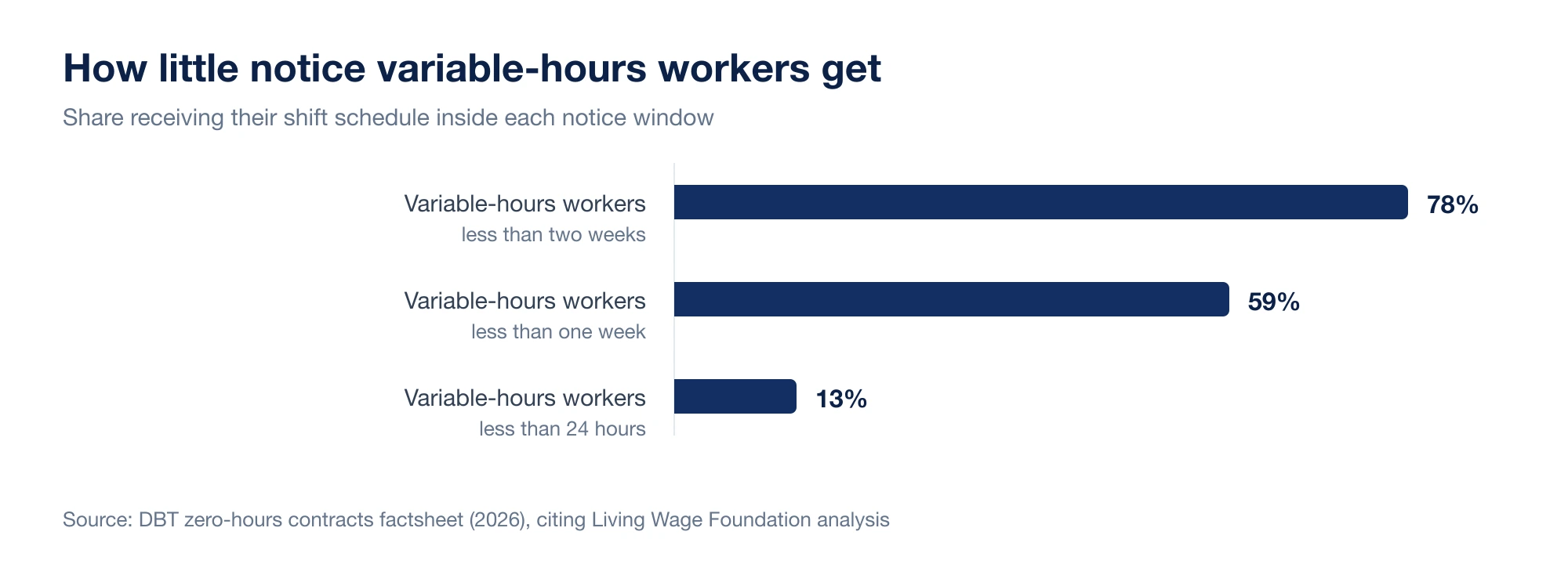
| Notice received | Share of variable-hours workers |
|---|---|
| Less than two weeks | 78% |
| Less than one week | 59% |
| Less than 24 hours | 13% |
Publishing earlier does not mean guessing demand perfectly. It means publishing the best plan you have, then handling exceptions as visible amendments instead of replacing history.
Can an employer change a shift without asking?
Sometimes, if the agreed terms clearly allow the relevant variation and the change is reasonable. Often, the safer and more accurate answer is to ask.
Changing Thursday from 09:00–17:00 to 10:00–18:00 under a clear variable-hours pattern is different from moving a Monday-to-Friday employee onto Sunday nights. A long-standing rota pattern can also become relevant evidence of the agreement even when the wording is vague.
Before changing a published shift, check:
- Contract: are the day, start time, finish time, location and number of hours fixed or variable?
- Notice: is there enough time for the worker to reorganise commitments and travel?
- Impact: could the change particularly disadvantage someone because of disability, sex, religion or another protected characteristic?
- Rest: does the new start leave at least the required rest after the previous shift? Most adult workers are entitled to 11 consecutive hours; see our rest breaks and working hours guide.
- Record: can you show the original shift, the proposed change, when the person was told and whether they accepted?
When the answer to the first question is unclear, agreement is cheaper than an argument. If the change would alter contractual hours permanently, follow a proper contract-change consultation rather than smuggling it through the weekly rota.
Does a cancelled or shortened shift have to be paid?
Today, the answer again starts with the contract and the worker's status.
GOV.UK says an employer can lay off an employee or put them on short-time working when it cannot provide paid work only if that is allowed by the employment contract, an enforceable agreement or a clearly established workplace practice, or the employee agrees to the change. A guaranteed shift should not simply be deleted on the assumption that publishing it created no obligation.
Zero-hours arrangements are different because work is not guaranteed before it is offered and accepted. Even there, the exact terms and what happened matter. If a person has already travelled, arranged care or turned down other work, late cancellation is poor practice now and is the precise problem the 2027 payment right is intended to address.
For a disputed cancellation, do not rely on a generic blog—including this one—to decide pay. Check the contract and ask Acas or an employment adviser about the facts.
What changes under the Employment Rights Act 2025?
The Act became law on 18 December 2025. For qualifying zero-hours, low-hours and agency workers it establishes a framework for three connected rights:
- Guaranteed-hours offers. An employer will have to offer eligible workers hours that reflect the hours they regularly worked during a reference period. The worker can decline and remain on their current arrangement.
- Reasonable notice. Eligible workers will have a right to reasonable notice of a shift and of an employer-led cancellation or change.
- Short-notice payments. An employer will have to pay when it cancels, moves or cuts short a qualifying shift at short notice, subject to the regulations and limited exceptions.
The framework also covers eligible agency workers. The Act distinguishes employer-led changes from worker-led ones: a voluntary shift swap or a worker cancelling because they cannot attend is not meant to trigger an employer cancellation payment.
Which details are still unknown?
This is the part many search results skip. The Act supplies the legal framework; regulations supply the operating numbers.
As at 19 August 2026, the government has not finalised:
- the low-hours threshold that brings a contract into scope;
- the length of the reference period used for guaranteed-hours offers;
- the notice period that will be presumed reasonable;
- the factors a tribunal will use when deciding whether shorter notice was reasonable;
- what counts as short notice for a cancellation, movement or curtailment;
- the amount of the short-notice payment and the limited exceptions.
The government's impact assessment used an expected 12-week reference period for modelling, but the official factsheet is explicit that the length will be set in regulations. Treat 12 weeks as a planning assumption, not settled law.
The latest government implementation timeline, updated 7 August 2026, says the rights will take effect during 2027 and that timings will be updated after consultation. Acas gives the same broad 2027 position.
What should a small employer do before 2027?
Do the work that improves the rota even if a regulation changes later.
1. Audit what the contracts actually say
For every shift worker, record whether hours are fixed, minimum or zero; whether days and times may vary; what notice language exists; and whether lay-off or short-time working is permitted. Compare the document with what happens in reality.
2. Measure notice instead of debating it
For each rota, store when it was first published. For each amendment, store when the worker was notified. After four weeks you will know your real notice window and which locations or managers create late changes.
3. Keep the original shift and the amendment
Do not silently overwrite 09:00–17:00 with 12:00–18:00. A useful record keeps both versions, the reason, the person who changed it, the notification timestamp and the worker's response.
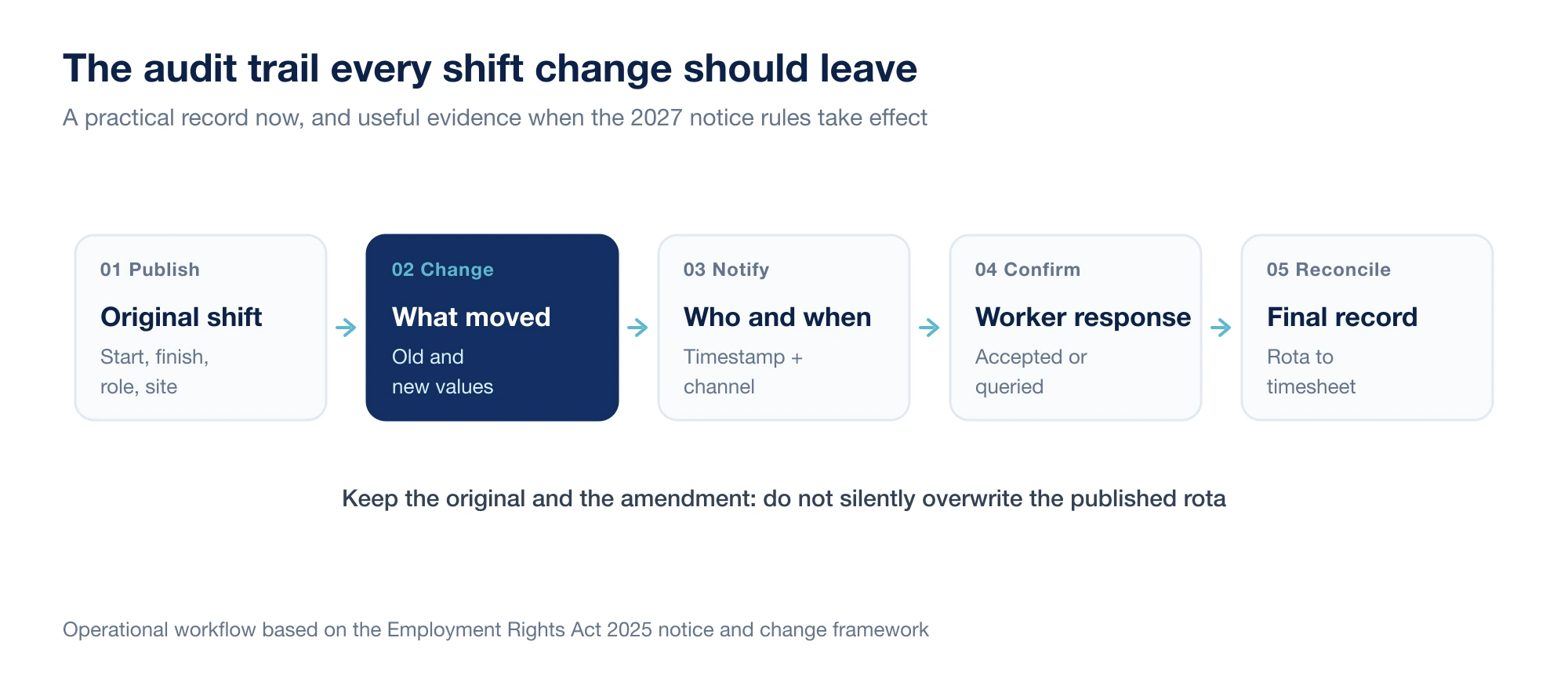
That same record prevents today's confusion and gives you evidence for tomorrow's reasonable-notice question.
4. Separate employer changes from worker changes
Code sickness, a voluntary shift swap, an employer cancellation and a demand-led reduction differently. The 2027 framework treats them differently, and your staffing data should too.
5. Connect the change to worked and paid hours
A shift that changes in the rota must flow into attendance and timesheets. Otherwise the employee sees the new time, the clock record expects the old one and payroll pays a third version.
6. Set a publication target and an escalation rule
For example: publish 14 days ahead; manager approval for any change inside seven days; explicit worker confirmation inside 48 hours. These are internal standards, not claims about the future law. They create a baseline you can adjust when regulations are final.
Weekola keeps the published staff rota, change history, swaps, attendance and timesheets connected, so notice is something you can evidence rather than something two people remember differently.
A shift-change checklist for managers
Before pressing save:
- Does the contract allow this particular change?
- Have I asked for agreement where it does not?
- Is the notice reasonable in the circumstances?
- Does the worker have enough daily and weekly rest?
- Have I checked leave, availability and another accepted shift?
- Is this employer-led, worker-led or a voluntary swap?
- Will cancelled or reduced hours still be payable under the current agreement?
- Are the old value, new value, reason, timestamp and response recorded?
- Will attendance and the timesheet now expect the correct person and time?
If the system cannot answer those questions, the rota is a picture rather than a record.
Sources and further reading
- GOV.UK: Employment Rights Act implementation timeline, updated 7 August 2026
- GOV.UK: reforms of zero-hours and similar contracts factsheet
- GOV.UK: impact assessment for shift notice and short-notice payments
- legislation.gov.uk: Employment Rights Act 2025 and explanatory notes
- Acas: Employment Rights Act 2025
- Acas: proposing changes to employment contracts
- GOV.UK: written statement of employment particulars
- GOV.UK: lay-offs and short-time working