

One person cannot work Tuesdays. Another can work Tuesdays but not past six. A third can work late, but only every other weekend, and has just started a college course that they mentioned once, in passing, in March.
None of that is unreasonable. It only becomes a problem because it lives in one manager's head, which means the rota is rebuilt from memory every week and every publication triggers a fresh round of negotiation.
The short version: write availability down, separate what someone cannot do from what they would rather not do, set a deadline with real consequences, and make the allocation of unpopular shifts visible.
This is a bigger part of the workforce than it looks
Flexible working patterns are not an edge case to be handled informally. The Department for Business and Trade's 2026 factsheet puts the number of people on zero-hours contracts at around 1.2 million, or 3.6% of everyone in employment. It identifies hospitality, transport, arts and other services, health and social care, and wholesale and retail among the sectors that rely most on them. Those are exactly the shift-based workplaces where availability lives or dies by the rota.
If your business runs on people whose availability genuinely varies, then managing availability is not admin around the edges of scheduling. It is the scheduling.
Separate availability from preference
This single distinction removes most of the friction, because the two things get argued about as if they were the same thing and they are not.
| Availability | Preference | |
|---|---|---|
| Means | Cannot work this time | Would rather not work this time |
| Examples | College Monday mornings, childcare pickup at 17:30, second job on Sundays, agreed contracted days | Dislikes closing, prefers weekends off, likes early shifts, prefers a particular team |
| How to treat it | Respected as a constraint | Considered, balanced across the team, not guaranteed |
| Changes | With notice, through the process | Anytime, no drama |
If every preference is treated as a hard rule the rota becomes unbuildable. If every hard rule is treated as a preference, people stop trusting you and eventually leave. Say which is which, out loud, and both problems shrink.
Notice is about to become a legal duty
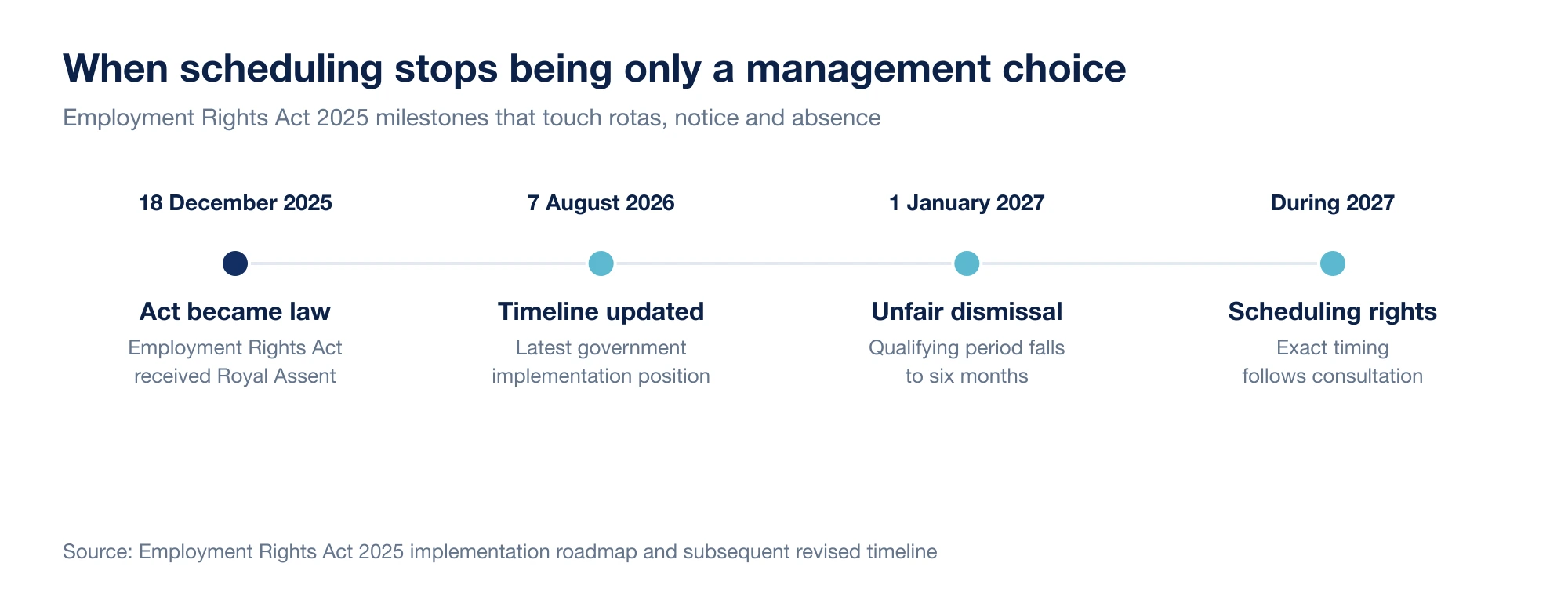
The rules around one-sided flexibility are changing. The Employment Rights Act 2025 introduces guaranteed hours reflecting the hours people regularly work, a right to reasonable notice of shifts and of changes to them, and payment where a shift is cancelled or cut short at short notice.
| When | What changes |
|---|---|
| 18 December 2025 | Employment Rights Act 2025 received Royal Assent |
| 7 August 2026 | Government published its latest implementation timeline |
| 1 January 2027 | Unfair dismissal qualifying period falls to six months |
| During 2027 | Guaranteed hours, reasonable shift notice and short-notice payments; exact timing to follow consultation |
Important details are still reserved for regulations: the reference-period length, the low-hours threshold, the notice period presumed reasonable, and the short-notice payment amount. Do not write invented numbers into contracts. Do keep a reliable history of hours, publish earlier and record changes properly; all three help now and create the evidence the future rules are designed around.
Collect availability before you build, not after you publish
The most common scheduling loop in a small business is: publish, receive five requests, edit, republish, confuse everyone. It repeats weekly and it is entirely avoidable by moving the requests before the build.
- Staff submit changes by a fixed day each week.
- The manager confirms what is accepted, in writing.
- The rota is built from the confirmed picture.
- Anything after that is a request rather than an expectation.
That last line does the heavy lifting. It does not say no. It says the answer depends on cover.
Make the deadline real without being harsh
A deadline that never has consequences is a suggestion, and everyone works out within a fortnight which of the two it is.
Real means consistent, not severe. "Changes for the week after next by Wednesday 17:00. After that, we will try, but we cannot promise." Emergencies obviously sit outside it. Repeated late changes from the same person become a private conversation rather than a rota problem.
People accept firm rules easily. What they will not accept is a rule that applies to them and not to somebody else.
Keep availability visible at the moment of decision
If the person building the rota has to search chat history, old notes and screenshots, mistakes are guaranteed. Whoever is scheduling needs to see, on the same screen as the grid: who can work, who cannot, which limits are permanent, which are temporary and when they expire, and what is still awaiting approval.
This matters most in multi-site teams, where a manager covering another branch may not know anyone personally and has nothing but the record to work from. It also matters when you are the second manager, or on holiday, or ill. Keeping availability in a system rather than a memory is what lets somebody else run the week.
Be honest that the business still needs cover
Fair scheduling is not the same as everyone getting what they want. Somebody has to work Sunday.
The honest framing is simple: agreed availability will be respected, and the remaining shifts still have to be covered by somebody. That means weekend and closing shifts rotate, popular shifts do not permanently belong to whoever asked first, and the rules apply to everyone including the manager's favourites.
Staff take on difficult shifts readily when they can see the pattern is shared. The resentment comes from opacity, not from the shift.
Protect boundaries, especially for part-time staff
Small businesses run on part-time people who are also studying, parenting, caring or holding down a second job. If the rota repeatedly pushes past those limits, you win the shift this week and lose the person in three months, and recruiting and training a replacement costs far more than the cover was worth.
Two boundaries are worth defending on principle. Eleven hours of rest between shifts under the Working Time Regulations 1998, so nobody closes at 23:00 and opens at 07:00. And the agreed maximum hours for people who told you they have a hard limit, even in a week when you are desperate.
Respecting boundaries is not soft management. It is retention, and retention is the cheapest labour strategy there is.
Share out the shifts nobody wants
Every business has them: late closes, early opens, Sundays, bank holidays, delivery days, short notice cover.
Pick a mechanism and say it publicly. A rotation, so everyone knows when their turn is. A premium for the genuinely unpopular ones. Or attaching them to a role, so senior pay comes with the closes. Any of these work. The one thing that does not work is silence, because when people cannot see the logic they will invent one, and the version they invent is never generous.
Then audit it monthly. Count the closes and the Sundays by person over the last eight weeks. If the distribution does not match the stated rule, fix the distribution before somebody else points it out.
Handle last-minute changes on a separate track
Sickness, transport, emergencies and sudden demand are not availability changes, and forcing them through the same process makes the process look weak.
Give them their own route: one place to report, a manager decision, and a recorded outcome so that the rota, attendance and timesheets stay accurate. Judgement is fine. Invisible judgement is not, because next month nobody will remember whether that Tuesday was sickness, absence or an approved swap.
When the same conflict keeps recurring
If a clash reappears every week, stop solving it weekly. A person who repeatedly cannot work their contracted hours, a department permanently short on Sundays, or a business that needs more closing cover than the team can offer are not rota problems. They are staffing model problems, and the answer is a different contract, another hire, more cross-training, or different opening hours.
Rebuilding the same compromise every seven days is the most expensive way to avoid one difficult conversation.
A sample availability policy
Short enough that people read it:
Keep your recurring availability up to date in the app. Changes for the following week must be submitted by Wednesday at 17:00. We will always respect agreed availability. Preferences are considered and balanced across the team, but cannot be guaranteed. Weekend and closing shifts rotate. Sickness and emergencies are reported to the duty manager and handled separately. If your circumstances change permanently, tell us and we will update your availability properly.
Nine lines. Plain language. Applied consistently, it will do more for rota fairness than any feature.
Weekola keeps recurring availability, temporary changes and pending requests visible while you build the week, so the rules you write are the rules the rota actually follows. See how it fits with rota planning and leave management.