

Wage cost is usually the largest number a small business owner can actually influence this week. It is also the one most often judged too late, from a payroll total, after every useful decision has already been made.
The interesting question is not how much you spent. It is whether the right people were on the floor at the moments that decided your week.
The short version: overstaffing shows up in payroll where you can see it. Understaffing shows up in lost sales, mistakes and turnover where you cannot. Work out what an hour genuinely costs, find your break-even, then staff demand windows rather than whole days.
Start with what an hour really costs
Almost every staffing decision gets made against the headline hourly rate, and the headline rate is not what leaves the bank.
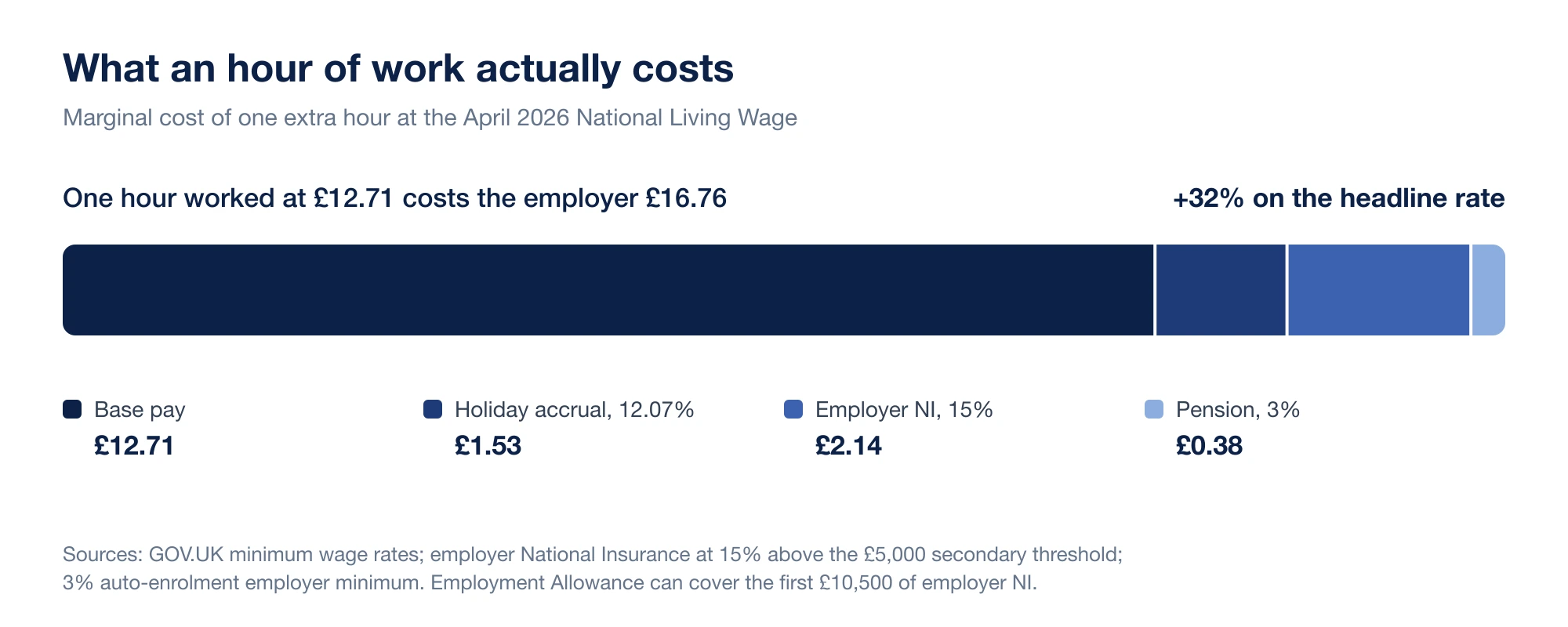
At the April 2026 National Living Wage of £12.71, an extra hour of cover carries employer National Insurance at 15% above the £5,000 secondary threshold, the 3% auto-enrolment pension minimum, and 12.07% of holiday accrual that will be paid eventually whether or not you think about it now.
| Component | Basis | Cost per hour |
|---|---|---|
| Base pay | National Living Wage, April 2026 | £12.71 |
| Holiday accrual | 12.07% of hours worked | £1.53 |
| Employer National Insurance | 15% above the £5,000 threshold | £2.14 |
| Pension | 3% auto-enrolment minimum | £0.38 |
| Marginal cost of one hour | £16.76 |
That is 32% above the headline rate. Two caveats worth knowing: the Employment Allowance can cover the first £10,500 of employer National Insurance, so the smallest employers may sit below the NI line for part of the year, and pension is calculated on qualifying earnings rather than every pound. Run your own numbers. The point is that the gap between £12.71 and the real figure is large enough to change decisions.
Then work out your break-even
Once you know the hourly cost, one hour of cover is worth adding whenever it protects more gross profit than it consumes.
Break-even sales per hour = hourly cost ÷ gross margin.
At £16.76 an hour and a 65% gross margin, an hour of cover pays for itself if it protects about £26 of sales. That is three coffees and a sandwich. Most owners guess considerably higher, and that guess is what produces thin peak cover.
What a thin shift actually costs
Take a Saturday lunch in a small cafe. Illustrative numbers, but the shape holds.
You cut one person from an 11:00 to 15:00 window. Four hours at £16.76 is £67 saved. Clear, visible, easy to feel good about.
Now the other side. Through that window the queue reaches eight people three times. Say six customers walk each time at an average spend of £9. That is £162 of sales gone, and at a 65% gross margin, roughly £105 of gross profit.
| Effect | |
|---|---|
| Four hours of cover removed | £67 saved |
| 18 lost covers at £9 | £162 of sales |
| Gross profit forgone at 65% | about £105 |
| Net effect on the day | about £38 worse off |
That is before the one star review about the wait, the tired team, and the closing tasks that slipped to Sunday morning.
You only need three numbers to run this for your own business: your all-in hourly cost, your average transaction value, and your gross margin.
What overstaffing really costs
Overstaffing is easier to see and easier to over-correct. Three people on a quiet Tuesday when one could cope is obvious, and the wage cost is real.
The subtler cost is that it hides weak process. If a shift only runs smoothly with an extra body on it, the problem may be prep, layout, training or unclear roles rather than demand. Adding people is the most expensive possible way to fix a badly organised shift, and it removes the pressure that would have exposed the real issue.
So before cutting hours, ask what the extra person was actually absorbing:
- Was the shift genuinely quiet, or was it busy and badly organised?
- Did each person have a defined area, or were three people covering everything loosely?
- Was slow time used for prep and cleaning, or lost?
- Was there a forecast at all, or was the rota copied from last week?
- Is this a one-off or a pattern?
Cutting hours is not a strategy. Better allocation is.
Staff to demand windows, not to days
Whole-day thinking is where most padding and most thinness both come from. Monday quiet, Saturday busy, so Monday gets three people all day and Saturday gets five all day. Both statements are wrong for about half of each day.
Break the day into windows, and staff each one to the work:
- Opening and setup
- First rush
- Mid-morning trade
- Lunch peak
- Afternoon lull, delivery and stock
- Late trade
- Close and cash up
Then separate fixed work from flexible work. Opening, serving, appointments, deliveries and closing happen at a time. Cleaning, admin, stock counts, training and some prep can move. A well-built shift parks flexible work in the lulls and protects the peaks from it. A lot of apparent understaffing at 12:30 is really a stock count that should have happened at 15:00. Building this into your rota software makes the pattern repeatable rather than something you rediscover each week.
Track the moments that felt wrong
You do not need forecasting software to get significantly better at this. You need a memory that outlasts the week.
At the end of each shift, the duty manager answers four questions in a shared note: when did we have too many, when were we stretched, where did a manager have to step in, and what did not get done? Ten seconds each.
After three or four weeks the patterns are unmistakable, and they are usually more specific than anyone expected. Not "Tuesdays are quiet" but "Tuesday from 14:00, unless there is a delivery". Not "Saturdays are hard" but "Saturdays are hard when Aisha is off, because she is the only other person who can run the pass".
Watch skill mix, not just headcount
Two people on a shift can mean completely different things. A supervisor plus a new starter is a functioning team. Two new starters is an incident waiting for a customer.
When you review labour cost, look at the mix:
- Do peak windows have enough experienced people, not just enough people?
- Is every new starter paired with someone who can actually train them?
- Are supervisors placed where decisions get made, or spread thin for coverage?
- Are your most skilled people doing low-value tasks during peaks?
- How many people can genuinely open and close? If the answer is two, your rota has no slack and one holiday request will break it.
Cross-training is a labour cost strategy that does not appear in any labour cost report. It is usually the highest-return one available to a small team.
Do not make staff absorb your planning
There is a version of labour control where the business flexes perfectly and the staff absorb all the uncertainty: hours cut at short notice, shifts that change every week, no ability to plan a life. It works for a quarter or two, and then your best people leave.
That exit is expensive, and hospitality feels it hardest: industry studies put annual churn anywhere between roughly 39% and 67% depending on the sample and sub-sector, against a UK all-industry average nearer a third. Every one of those leavers takes recruitment time, training hours and a period of reduced productivity with them.
The balance to aim for is stable patterns where possible, honest notice where demand really is variable, and fair distribution of both the good and bad shifts. If every quiet shift goes to one person and every brutal one to another, the numbers can look fine while the team quietly falls apart. Clear availability rules are what make that balance holdable.
A twenty minute weekly review
- Compare planned hours with actual hours, by day. The payroll hours calculator is enough if you are not doing this in software yet.
- Mark the shifts that felt too heavy or too thin, using the duty manager notes.
- For each one, decide the cause: demand, skill mix, absence, or planning.
- Look for repeats across three weeks before changing anything structural.
- Adjust next week by window, not by whole days.
Do this consistently and staffing arguments largely stop, because you are debating a pattern rather than an opinion.
What this adds up to
Labour control is not spending as little as possible. It is putting the right people in the moments that decide whether customers come back.
The cheapest rota and the best rota are almost never the same rota. The best one has a reason behind every shift, and you can say the reason out loud.